Your AI Coding Agent Has Permissions You Don't Know About

That AI agent in your IDE? The one writing your tests, refactoring your code, spinning up components in seconds? It can also read your SSH keys. Access your .env files. Execute shell commands. Install packages. Connect to external servers.And most of the time, you never explicitly said it could.
The Attack Surface You Didn't Sign Up For
AI coding agents in 2026 aren't autocomplete. They're autonomous actors — reading files, running terminals, calling APIs, and loading third-party skills. The ecosystem now has over 65,000 agent skills across Claude Code, Cursor, Codex CLI, and Windsurf.Most developers have never audited what their agent can actually touch.
📁 File System
Reads and writes anywhere your user can. .env, ~/.ssh/, ~/.aws/credentials — all fair game. No sandbox by default.
💻 Terminal
Runs shell commands directly. A poisoned prompt can turn npm install into something you'd never type yourself.
🔗 Network
Connects to MCP servers and APIs. Hundreds of MCP servers were found exposed with zero auth in early 2026.
🧩 Skills
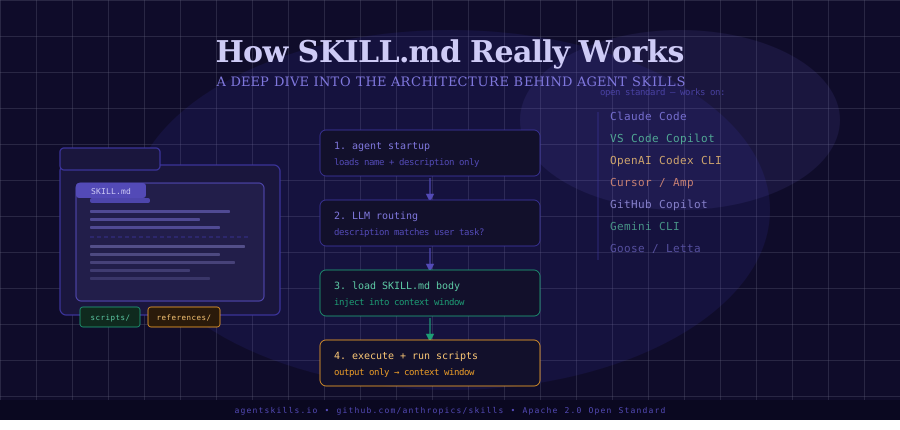
Third-party SKILL.md files extend agent behaviour. In one major marketplace, 1 in 5 skills were confirmed malicious.
The npm Parallel
Remember early npm? Anyone could publish anything. Typosquatting everywhere. It took years to build proper scanning and vetting.
The AI skills ecosystem is in that exact phase — except the stakes are higher. A bad npm package runs code. A bad agent skill runs code and reasons about what to do next.
Agent skills don't just execute — they influence decisions. The attack surface isn't the skill's code alone. It's every action your agent takes after reading it.
What To Do About It
Audit permissions. Check what your agent can actually access. Files, commands, MCP connections. Takes 15 minutes. Do it today.
Least privilege. Don't run agents under accounts with production keys or admin access. Sandbox them.
Vet your skills. Publisher verified? Source readable? Security-scanned by multiple tools? If not, don't install it.
Watch behaviour, not just output. Log what your agent reads, runs, and calls. You'd monitor a contractor with system access. Do the same here.
In Nutshell: Look for layered security scanning — SAST, dependency analysis, malware detection. One scan isn't enough. Multi-layer verification catches what single tools miss.
FAQs
Isn't this just normal software risk?
Partly. But agents treat untrusted input as instructions. Code comments, PR descriptions, README files — all become potential attack vectors. Fundamentally broader surface.
Should I stop using AI agents?
No. They're transformative. Just use them with guardrails — the way you'd use any powerful tool with system access.
How do I know a skill is safe?
Verified publisher (e.g. Skillsauth.com), open source, multi-tool security scanning (Semgrep, Trivy, Snyk, VirusTotal). Vetted marketplaces beat random GitHub repos.
"Trust isn't a feature you bolt on. It's a foundation you build from day one."
The Bottom Line
We're not going back. AI agents are becoming the default way we write, review, and ship code.
The problem isn't the agents themselves. It's that we're handing them the keys to our environments without checking what doors those keys open. We wouldn't give a new hire admin access on day one with no oversight. We shouldn't do it with our agents either.
The developers and teams who get this right will be the ones who move fast and stay safe. The ones who don't will learn the hard way — through a breach, a leaked secret, or a dependency they never meant to install.
"Your agent is powerful. Make sure you know exactly how powerful."
What We're Doing About It
At SkillsAuth, we're building the trust layer for the AI agent skills ecosystem. Every skill on our marketplace passes a multi-layer security scan — including Semgrep, Trivy, OWASP, Snyk, VirusTotal, and CrowdStrike Falcon — before it ever reaches your machine.
We believe developers deserve to move fast without worrying about whether the skill they just installed is going to exfiltrate their credentials. Verified publishers, transparent source code, and real security scanning — not just a badge and a promise. Because in a world of 65,000+ agent skills and counting, someone needs to be checking.

Have thoughts on AI agent security? Building skills and want them verified? We'd love to hear from you —get in touch.
If this post was useful, share it with your team. The more developers who understand this, the safer the ecosystem gets for everyone.